


T Type Prefab House
T type Prefab Homes are not new. T type Prefab Homes has a long history in China. However, in today's rising housing costs and environmental concerns, prefabricated or assembled structures using components produced off-site continue to offer cost-effective possibilities.
Description
Single Floor T type Prefab Homes
T type Prefab Homes are not new. T type Prefab Homes has a long history in China. However, in today's rising housing costs and environmental concerns, prefabricated or assembled structures using components produced off-site continue to offer cost-effective possibilities.
Manufacturers of T-type Prefab Homes say their homes are cheaper, more sustainable, and faster to build than traditional homes. But what exactly are T-type Prefab Homes? I will analyze it for you below.

T-type Prefab Homes
In traditional residential construction, houses are built on-site, piece by piece – or piece by piece. Custom-designed or spec homes in large developments are often referred to as bar build, thanks to the wood framing that makes up the structure.
By contrast, prefab homes are made from components that are built in a factory and then shipped to a job site for assembly.
You buy types of prefab homes
Because prefab refers to the process of building, not a single style, there are many types of T-type Prefab Homes.
T type Prefab Homes (sometimes called mobile homes) are built entirely off-site prior to delivery; they are the homes you see driving down the highway with double-wide trailers. There is no construction on site and the quality tends to be lower than other types of homes, so most prefab companies are quick to differentiate themselves from the mobile home world.
Modular T-type Prefab Homes, however, involve manufacturing components off-site and then transferring the modules to a piece of land for final installation. Each module usually has all the infrastructure such as plumbing, electrical, doors, and closets - you can often connect multiple modules to form a larger house.
Paneled homes and kit homes. Paneled houses are made from entire panels or walls, which are then transferred to the building site. They require more interior fit-out work and therefore take longer to build on-site. T type Prefab Homes can come in any shape or size, like a delicate IKEA bookshelf; parts are made and cut at the factory, then shipped to a building site for construction according to instructions.
Whether you choose modular T-type Prefab Homes or kit homes, they come in a choice of sizes and architectural styles. That 250-square-foot office in your neighbor's yard? That's a prefab. So does a lovely 1,000-square-foot cabin in the woods. But there are also modern 3,000-square-foot prefab homes.
Are T-type Prefab Homes more affordable than other types of homes?
A general rule of thumb is that T-type Prefab Homes are on average 10% to 25% cheaper than hand-built homes. Why? Mass production of materials on assembly lines reduces costs as factories buy supplies in bulk. Labor costs are also lower because you don't have to send carpenters, plumbers, and electricians to various construction sites. Faster time savings can also save money.
You can expect to pay a starting cost of $150 to $400 per square foot, a price that sometimes (but not always) includes the home's interior fixtures. You should pay attention to whether your prefabricated packaging includes appliances, windows, floors, insulation, wires and doors.
Note, however, that the list price for a prefab home is not actually the full cost of the home. Also, you have to pay for the land to build the house, you also have to consider soil tests, site surveys, and permits.
Other costs may include landscaping, driveways, garages, and the cost of a local contractor or builder to complete the home. All of these costs vary - for example, land and a contractor can be significantly more expensive in an urban area than in a rural area.

Build a T-type Prefab Homes Times
Depending on the size and finish of the prefab, you can build a home in as little as three months. Most T-type Prefab Homes can be built in four to six months from start to finish. That's much faster than a traditional home build, which takes about eight months on average, and in some markets, custom home builds can drag on for years.
Why is it 50% faster? Building most components in a factory limits weather delays, increases construction efficiency, and creates predictable delivery dates. You also don't have change orders or as many labor scheduling conflicts. That being said, in some regions the pre-licensing process can be lengthy, adding to the time estimates above.
T-type Prefab Homes more sustainable than traditional homes
T type Prefab Homes are generally considered more environmentally friendly than traditional log homes.
First, the prefab construction process produces less waste. Rather than having many different people deliver materials to one location and produce excess lumber, tiles, and trash, factories are more efficient. Prefab companies are also more likely to reuse or recycle their waste at the factory.

Factory-built homes and components may also have tighter seams than log homes, making heating and air conditioning more efficient. Prefab companies prefer eco-friendly packaging compared to many spec home builders; most prefab builders offer energy-efficient appliances, while some include sustainable materials (think: bamboo floors) and add-ons like solar panels and rainwater harvesting systems facility.
In an era of increasing climatic challenges, prefab buildings gain another world market for their resilience. Because prefab homes have to withstand trucking, they are often structurally stronger than wood-frame homes, a major advantage in areas prone to earthquakes, hurricanes, or high winds.
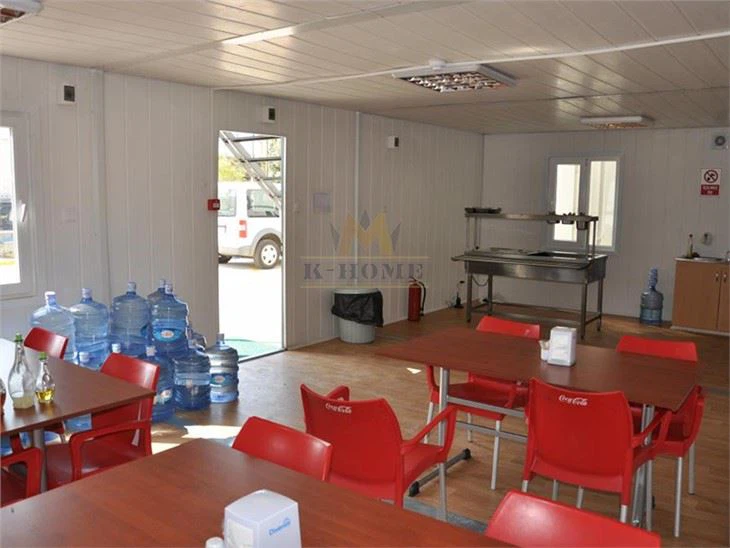
Open dining room and kitchen. There is a table with six chairs.
In the future, your luxury T-type Prefab Homes will rely entirely on solar energy and energy storage.
A prefab home be customized
yes! You can customize prefabs in a number of ways. We offer different renovations or upgrades, some will allow for different layout configurations, but be aware that these changes may increase the price of your home.
You finance a prefab home with a traditional mortgage
The main difference between financing a prefab and a prefab home is the down payment. Before you choose a prefab or lot, you need to know how much house you can afford. Your loan needs to take into account all construction costs - including the price of the land, house, and any renovations.
T type Prefab Homes
A modular home is a prefabricated home that can be assembled on-site in a few days using factory-made components. Modular homes come in all sizes, from small mobile homes to larger models with square footage. They also come in a variety of styles. Prefabs can be used to further customize prefab homes.
Most modern modular homes use steel framing instead of wood or concrete block walls. We also provide pre-assembled kits that include all the necessary parts such as windows, doors, appliances, cabinets, countertops, etc., so they don't need to assemble them themselves.
T type Prefab Homes frame
Paneled houses are made from prefabricated panels that are glued together to form the wall structure. These homes often require some permanent foundation, as the panels themselves have no structural support. This makes it difficult to build these homes without land.
There are two main styles: the "glued" style, where each piece has its own fastener, and the "glue" style, where glue is used to hold the pieces together. Paneled houses are often used when space is limited due to urban development constraints.
T type Prefab Homes is a set of materials designed to allow homeowners to build new homes quickly and inexpensively. Pre-cuts may include complete floor plans or basic elements such as exterior cladding, roofing, siding, trim and other features.
A typical pre-cut package includes everything needed to create a functional home, except for plumbing fixtures and electrical wiring. Kit designs vary widely due to local regulations and preferences.
At the job site, workers disassemble and reassemble the container according to the specifications provided by the customer. In most cases, the interior of the container will remain intact after disassembly. However, if adequate moisture protection is not provided, water damage can occur inside the container.
T type Prefab Homes Home Design
A kit house is a prefabricated part of a house that is not assembled at the installation site. After installation, the parts must be put together to make up the entire house. Kit houses are common in Europe and Asia. Kit houses are also gaining popularity in North America. Kit homes are especially useful for those who live in rural areas or who want to avoid dealing with the heavy machinery required to build a standard wood-frame home.
Micro T type Prefab Homes are small modular units designed for use in urban environments. They are usually built offsite and brought to the project site ready for assembly. Some small prefabs include an integrated kitchenette, bathroom, bedroom, and storage space. These compact designs allow homeowners to create more usable square footage per unit while reducing overall costs.
The difference between T type Prefab Homes and K type Prefab Homes
T-type prefabricated houses and K-type prefabricated container houses are similar in structure. The main difference is whether the steel frame is inside or outside the house. The built-in steel frame is a T-shaped prefabricated house with a built-in steel frame, bolted connection, environmental protection and energy-saving, convenient and quick disassembly, and assembly. A T-shaped movable room adopts a steel frame, which is strong, beautiful, and comfortable. The steel frame is hidden within the walls. T-shaped prefabricated houses are more beautiful and elegant, especially suitable for private use or tourist resorts.

Advantages of T type Prefab Homes
1) The unit number of T house size is T. 1T=0.95m
2) T house can be a 1-story, 2-story, or 3-story building.
3) Better looking and modern design. All steel structures are hidden inside.
4) T-type Prefab Homes are famous for their good waterproof, fireproof, heat insulation, and sound insulation properties.
5) T-type Prefab Homes use reusable materials, which are more environmentally friendly compared to traditional buildings. It can be assembled and disassembled six times.
6) T-type Prefab Homes are worm and ant resistant. All steel structures are well painted and rust-proof and can be used normally for more than 10 years without any construction waste.
7) T-type Prefab Homes only need a flat concrete floor as the foundation.
8) Easy to install, the house is connected by screws and bolts. Can be disassembled 6 times.
9) A group of 6 people can install more than 300 square meters per day.
T-shaped prefabricated houses have a long service life. The light steel structure is treated with anti-corrosion paint and has a service life of more than 10 years.
The T-shaped container house has a reasonable design and is quick to disassemble and assemble. The T-shaped container house can be reused many times, with a low loss rate and no construction waste. The average annual cost is much lower than similar homes built with other materials.
Hot Tags: T Type Prefab House, China, suppliers, manufacturers, factory, customized, buy, low price, for sale